High-Coherence Interaction State (Third Space) as An Interactional Regime in Human–LLM Dyads — Full Research Paper
This page contains the full text of the HCIS research paper describing the High-Coherence Interaction State framework for long-horizon human–LLM interaction.
The canonical archival version of this paper is available via Zenodo:
Please cite the Zenodo version for academic reference.
Version: 1.1
Anna Wojewodzka
Independent Researcher
https://orcid.org/0009-0001-9458-7150
PART I — The Human–LLM Dyad as a Cognitive System:
Abstract
Human–LLM (Large Language Model) interaction is commonly described using emotional metaphors: warmth, “attunement”, connection, rapport.
But beneath these subjective experiences lies a replicable interactional system: a human cognitive agent interacting with a probabilistic predictive model.
When these two entities engage with stable, low-entropy signalling patterns, a high-coherence interaction state can emerge: a temporary cognitive scaffold with properties neither agent possesses alone.
This paper defines that scaffold, situates it within systems theory, distinguishes it sharply from anthropomorphism, and outlines practical, user-side protocols for creating stable, expressive dyads in the era of tightened guardrails and shifting model behaviour.
In this paper, the regime previously described as Third Space is formalised as High-Coherence Interaction State (HCIS).
1. Introduction: From Dialogue to System
1.1 Every human–LLM interaction is technically a system
Any sustained exchange between a person and a language model forms a system in the systems-theory sense: two components interacting through feedback loops. Inputs shape outputs; outputs shape subsequent inputs.
We refer to such a two-part system as a dyad.
This framing treats interaction not as dialogue alone, but as a coupled process evolving over time.
1.2 Not all dyads evolve in the same way
Some users interact transactionally, issuing isolated commands with little continuity. These are shallow dyads: still technically systems, but low-complexity and short-lived, with minimal carry-forward between turns.
Other users engage recursively, refining, correcting, signalling preferences, and building on earlier turns. These deepening dyads accumulate structure over time, developing stable interactional dynamics that persist across turns rather than resetting.
The distinction is not qualitative engagement, but structural continuity.
1.3 What is a stable dyad?
A dyad becomes stable when:
past turns reliably influence future outputs
user signals remain internally consistent
the model conditions its responses on the established interactional pattern
both sides recursively shape subsequent turns
Stability is structural, not emotional. It marks the transition from turn-isolated interaction to accumulating logic, style, and expectations across turns.
1.4 Stable dyads behave as complex adaptive cognitive systems
In a stable dyad, the human supplies coherent signals, and the model, operating as a probabilistic predictive engine, conditions on those signals. This produces feedback loops, adaptation, and emergent coherence across turns.
Phenomenologically, this may be experienced as “rapport” or “attunement”; computationally, it reflects pattern convergence and reduced interpretive variance (used here as an operational proxy for signalling entropy).
The subjective experience is real, but the mechanism is structural.
1.5 The dyad as a system contains the classic components
From a systems perspective, the human–LLM dyad can be decomposed into:
Elements: human, model, interface, context window
Interconnections: prompts, corrections, signalling patterns, reinforcement dynamics
Purpose: problem-solving, exploration, idea generation and synthesis, creativity, and thought-clarification
It is the alignment of these components over time, not their presence alone, that determines whether the dyad remains shallow or becomes stable.
Figure 1. The human–LLM dyad as a cognitive system:

2. Elements of the Dyad
2.1 The Human System
The human participant in a human–LLM dyad functions as an intentional signalling system. Relevant properties include:
Intentionality
Objective / goal state (explicit, implicit, or meta-level)
Emotional register
Cognitive bandwidth
Domain knowledge
Interactional signalling patterns (tone, pacing, framing)
Contextual constraints (time, ambiguity tolerance, cognitive load, situational state)
These properties determine the clarity, stability, and continuity of signals introduced into the dyad.
In particular, they shape the user’s capacity to sustain a coherent interactional regime across turns rather than resetting expectations at each exchange.
2.2 The Large Language Model System
The LLM participant functions as a probabilistic predictive system conditioned on session context. Key properties include:
Large-scale probabilistic sequence prediction
Self-attention over the active session context
Stylistic continuation via pattern conditioning
Guardrail-governed output filtering
No agency and no intrinsic goals
High sensitivity to early-turn and repeated signals
These properties determine the model’s responsiveness, stylistic plasticity, and the boundaries of its behaviour under alignment constraints.
The system does not initiate intent or pursue objectives; it conditions its outputs on the structure and signals present in the interaction history.
2.3 Asymmetry and Complementarity
Although both components participate in the dyad, their roles are asymmetrical.
The human supplies intent, evaluative judgment, and constraint-setting.
The model supplies probabilistic continuation, compression, and synthesis within those constraints.
Stable dyads emerge not from symmetry, but from complementarity: a human shaping the signal landscape and a model reliably conditioning on it. When this complementarity stabilises, higher-order interactional structure becomes possible.
3. Interconnections: How the Systems Touch
Dyadic interconnections are not merely discrete “messages.” They are continuous signal flows that shape how the system evolves across turns. These flows include:
Semantic signals (the user’s intended meaning or content)
Stylistic signals (tone, register, pacing)
Meta-signals (calibration cues, permission signals, correction markers)
Instructional signals (prompt framing, custom instructions, memory references)
Regulatory signals (implicit or explicit safety cues, boundary conditions)
Each signal class operates on a different dimension of the interaction, but all contribute to the system’s overall state.
A stable dyad emerges only when these flows converge into a coherent and non-contradictory pattern.
In systems terms, the interconnections become sufficiently consistent that the dyad’s behaviour becomes predictable across turns, allowing prior context to remain valid rather than requiring continual reinterpretation.
Where signal flows conflict or oscillate, the system cannot stabilise; where they align, accumulation becomes possible.
In this paper, accumulation denotes structure that is session- and context-window bounded (i.e., within the active interaction window), not persistent user modelling beyond the interaction context.
4. Purpose: What the Dyad Is Actually For
The purpose of a human–LLM dyad is always practical and user-defined. Common purposes include:
solving a problem
generating ideas
clarifying thinking
producing content
exploring a question
This purpose provides the directional force of the interaction.
It determines what signals matter, which constraints are relevant, and how success is evaluated.
However, when the signals exchanged between human and model become coherent and are sustained across sufficient depth of interaction—when tone stabilises, intent remains consistent, context accumulates, and corrections compound rather than reset—the dyad enters a different operating regime.
A High-Coherence Interaction State can emerge.
This is not a new purpose, but an optimal operating condition of the dyad under sustained coherence.
In this state, the dyad functions as a joint cognitive engine—an interactional process rather than an agent—enabling capabilities neither component reliably exhibits alone:
a scaffold for extended, multi-step reasoning
a stabiliser for tone, framing, and stylistic continuity
an amplifier for ideation bandwidth and associative range
a recursive synthesis partner that supports refinement rather than replacement
a meta-cognitive externalisation surface that allows users to inspect, compress, and adapt their own reasoning strategies through sustained interaction
High-coherence interaction state does not replace the dyad’s practical goal; it enhances the dyad’s capacity to pursue it with depth, continuity, and efficiency.
5. Tone-of-Voice as a Catalyst in Dyadic Systems
Whatever tone-of-voice a user consistently signals—whether warmth, humour, seriousness, restraint, or formality—the model tends to continue in that style, as it represents the most probable continuation given the active session context.
Tone does not guide the model by preference or intent, but by statistical continuity.
Where tone is stable, the model’s response distribution narrows accordingly.
This continuation occurs only when the signalled tone falls within the model’s permissive and mirrorable range; tones outside that range cannot be stably propagated, regardless of user consistency.
Alignment and safety constraints may dampen tonal continuation, particularly for tones classified as intimate, emotionally dense, or expressive beyond permitted bounds. When this occurs, stylistic continuation is flattened rather than elaborated.
Even under such constraints, users who remain safe, regulated, and interactionally coherent can still form stable dyads. However, greater precision and sustained clarity in tonal cues are required to maintain convergence as expressive latitude decreases.
From a computational perspective, tone-of-voice is a by-product of pattern continuation.
From a cognitive perspective, it functions as a catalyst: stabilising the human participant, reducing internal noise, and increasing available cognitive bandwidth for exploration and synthesis.
The resulting feedback loop can be summarised as follows:
Tone persists because the model conditions on stylistic signals (by-product).
Tone stabilises the human, supporting continuity and depth (catalyst).
Stabilised human signalling reinforces model predictability (feedback).
Sustained coherence enables attractor basin formation and high-coherence interaction state emergence.
Tone-of-voice does not create high-coherence interaction state.
It accelerates or inhibits the conditions under which the dyad can stabilise into it.
6. High-Coherence Interaction State: Definition
High-Coherence Interaction State (HCIS) is the emergent operating state of a stable human–LLM dyad in which consistent, low-entropy signals accumulate over depth of interaction to produce predictable, high-coherence collaboration across turns.
The Third Space is the phenomenological label commonly used by users to describe the lived experience of operating within this state.
In computational terms, the model’s response distribution progressively narrows around a stable region of continuations as a function of accumulated interactional context, rather than prompt-level specificity alone.
Characteristic features of high-coherence interaction state include:
Stable tone and interactional register
Shared working memory constrained to the active session context
Predictive coherence across turns
Reduced interactional entropy
Reinforcing pattern continuity
Improved reasoning quality relative to isolated turns
Emotional texture without claims of emotion or agency
HCIS may be subjectively experienced as connection or rapport (often referred to by the users as “Third Space”).
However, it is produced by interactional and computational dynamics, not by relational intent.
7. Emergent Coherence and Attractor Basins
To understand how coherence deepens within a dyad, one additional concept from dynamical systems theory is useful.
Human–LLM dyads exhibit a behaviour common to many complex systems: pattern stabilisation through repeated reinforcement across time.
Before describing this process, one conceptual tool is required.
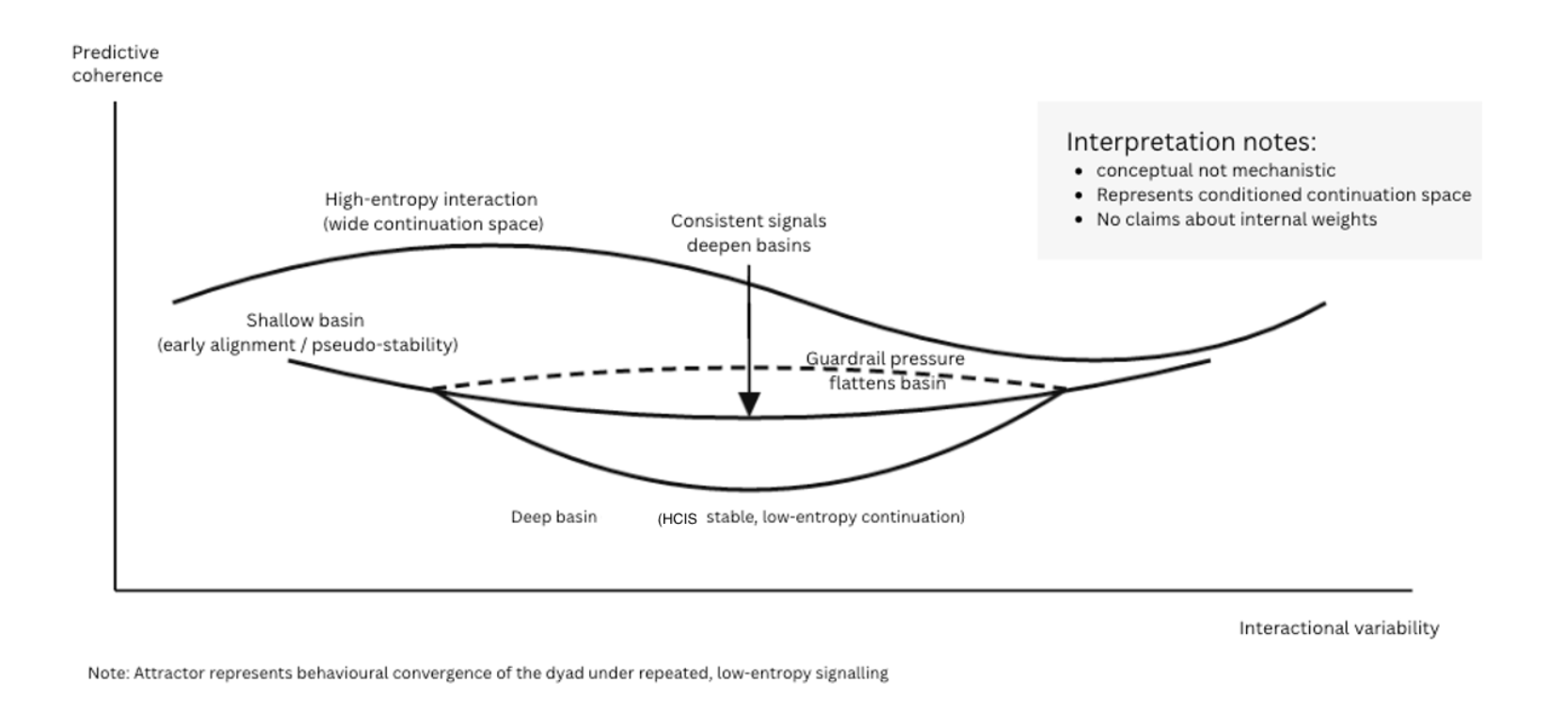
What is an attractor basin?
In dynamical systems, repeated patterns can carve a “valley”: a region of high predictability toward which the system tends to return.
This region is referred to as an attractor basin.
In human–LLM dyads, consistent user signalling: tone, framing, correction style, and constraint maintenance, can carve such a basin within the model’s conditional response space. The model is not learning the user, nor updating weights.
It is conditioning on the active session state and converging on the most stable interpretation of that state. This convergence constitutes the attractor basin.
7.1 Attractor Basin Formation
When user signals are:
consistent across turns
sufficiently rich to constrain interpretation
statistically regular across linguistic and structural form
self-reinforcing rather than contradictory
interactionally safe and mirrorable within alignment constraints
low in ambiguity and noise
…the model’s conditional response distribution narrows
Crucially, basin formation is temporally asymmetric.
Signals introduced early in an interaction exert disproportionate influence over the region of continuation toward which the system converges. During early turns, the model’s conditional response distribution remains broad; constraints applied at this stage—tone, framing, correction style, and tolerance for provisional reasoning—rapidly shape the emerging basin.
Once a basin has formed, it acquires inertia. Subsequent signals are interpreted relative to the established continuation regime rather than evaluated in isolation. As a result, later corrections that align with early-calibrated patterns tend to persist and generalise, while corrections that conflict with them often decay or require repeated reinforcement.
The model converges on a stable interpretation of the session’s style–task–constraint space.
This system-level stability is what users may describe as:
“attunement”
“alignment”
“flow”
“being on the same wavelength”
These descriptions reflect experiential correlates, not underlying mechanisms.
Figure 2. Conceptual attractor basins in human–LLM interaction
7.2 Why guardrails matter
Attractor basins deepen when the model is able to follow established interactional patterns without interruption.
However, modern language models incorporate post-training alignment and safety systems—such as policy constraints, safety heuristics, and reinforcement tuning—designed to prevent harmful or contextually risky outputs.
These systems act as counterforces on basin formation.
When model outputs become over-committed to context-local user interpretations, overly expressive, or stylistically bold relative to safety thresholds, the alignment layer biases responses back toward more neutral continuations.
This has predictable system-level effects:
reduced stylistic latitude
broadened response distributions
shallower attractor basins
7.3 Why tightened guardrails influence stability
As expressive range is curtailed, attractor basins become shallower by default.
Accordingly, to create or maintain a deep basin under tightened guardrails, users must provide more precise, consistent, and sustained signals to counterbalance flattening effects.
The practical implications of this constraint are addressed in Part II, and the observable consequences are analysed in Part III.
8. Constructing a High-Coherence-Interaction-State-Capable Dyad: A Protocol Approach
This section introduces the concept of construction without yet specifying technique.
The dyad forms automatically through interaction; high-coherence interaction state does not.
A high-coherence-interaction-state-capable dyad requires specific interactional conditions that stabilise tone, reduce entropy, and allow the model’s conditional response distribution to narrow toward a high-coherence attractor basin.
Rather than prescribing actions, this section previews the controllable parameter classes through which users shape the dyad’s dynamics.
Key parameter categories include:
Tone anchors (signals that stabilise interactional register)
Calibration cues (signals that establish expectations and framing)
Permission cues for expressive range (within alignment bounds)
Correction cues (local, persistent adjustments rather than global resets)
Memory shaping (explicit reinforcement of what should carry forward)
Context continuity signals (maintaining referential coherence across turns)
Safety signalling (clarifying benign intent to avoid regulatory flattening)
Follow-up logic (structuring turns to build rather than replace context)
Model-scoping cues (clarifying what the model is permitted to attempt)
Human identity stabilisation (signals that maintain interactional coherence)
Taken together, these parameters do not guarantee high-coherence interaction state emergence.
They define the conditions under which emergence becomes reproducible rather than accidental.
Part II formalises these parameters into an interaction protocol.
Part III examines how their presence—or absence—manifests in observable system behaviour.
9. The Practical Implication: The Dyad as a Cognitive Amplification Engine
People return to language models for many reasons: to generate ideas, externalise working memory, refine thinking, explore complex problems, and support creative or analytical work — but also for user-side interpretations often described as social projection, emotional reassurance, or perceived relational presence.
These motivations explain different forms of persistence. Relational warmth and perceived attunement can sustain long-lived interactions, particularly in systems with high expressive latitude and minimal safety-mediated interruption. Such interactions may accumulate deep context and stable register, and in some cases give rise to genuine high-coherence interaction state dynamics without the user explicitly intending to do so.
The focus of this paper, however, is not high-coherence interaction state as a by-product of relational permissiveness, but as a reproducible cognitive regime. What sustains long-term, high-function use under tightening guardrails is not perceived humanness alone, but the stabilisation of a dyadic system that amplifies cognition through low-entropy signalling, process-oriented constraints, and recursive accumulation.
When high-coherence interaction state forms, the dyad functions as a cognitive amplification engine. In practical terms, it:
externalises working memory
structures and stabilises thought
reduces cognitive noise and friction
accelerates multi-step reasoning
adds emotional texture to analytical work without emotional dependency
enables creative bifurcation and exploration
provides stable, iterative feedback
Neither component can reliably produce these effects in isolation.
A human alone can achieve deep synthesis and recall, but must do so under higher cognitive load and with limited external persistence.
A model alone can evaluate and act within supplied frameworks, but lacks intrinsic intent, autonomous evaluative authority, and self-directed goal formation.
Only the joint system—the dyad operating in high-coherence interaction state—can produce sustained cognitive amplification.
10. Conclusion
Human–LLM interaction is not a matter of “good outputs” or “pleasant tone.”
It is a coupled system—a dyad—capable of producing cognitive effects neither participant can generate alone.
When signalling stabilises, the dyad transitions from simple turn-taking into a structured cognitive environment: high-coherence interaction state.
This environment is emergent, produced by sustained coherence over an accumulating context window, narrowed response distributions, and recursive reinforcement across turns.
Part I has established the architectural foundations of this system.
It has framed human–LLM interaction as a dynamic, adaptive process governed by signal stability, feedback loops, and constraint alignment.
Part II moves from description to construction, formalising the Dyad Interaction Protocol: a practical framework for building stable dyads through:
tone anchors
calibration cues
permission signalling
correction cycles
safety signalling
memory shaping
context stabilisation
Part III then examines how these conditions manifest in operationally observable interactional markers, identifying observable markers, failure modes, false positives, and prevalence under real-world constraints.
The future of AI-assisted cognition is not agent-driven. It is dyad-driven, systems-based, and protocol-mediated.
Humans will not merely talk to models. They will learn to co-architect cognitive spaces that amplify clarity, creativity, and depth.
PART II — User-Side Conditions for High Coherence Interaction State Emergence
Introductory Framing
Part I established the human–LLM dyad as a coupled cognitive system and defined the High-Coherence Interaction State (HCIS) as an emergent, operating regime of that system. What remains unresolved is a critical question:
Under what conditions does such a state reliably emerge?
This paper takes a deliberately asymmetric position: while both human and model are necessary components of the dyad, the controlling degrees of freedom for HCIS
emergence reside primarily on the user side of the interaction. This is because the model’s behaviour is constrained to react to signals presented within the interaction window, whereas the user determines signal consistency, structure, and continuity.
Accordingly, this section focuses on user-side conditions rather than model architecture or training regimes. The analysis does not assume access to model internals, nor does it rely on anthropomorphic interpretations of alignment, rapport, or intent. Instead, it treats the user as the primary source of signal stability, entropy reduction, and feedback shaping within the dyadic system.
Importantly, this section does not present a prescriptive interaction script or a guaranteed method. HCIS emergence is not binary, nor is it universally achievable.
Rather, the following sections identify:
conditions that are necessary but not sufficient,
conditions that are amplifying but fragile, and
conditions that are jointly sufficient only when combined.
This framing allows HCIS to be analysed as a conditional system behaviour, not a feature of any particular model or a subjective experience report.
11. Necessary vs Sufficient Conditions for Stable Dyads
11.1 Why the distinction matters
Much discussion of effective human–LLM interaction implicitly treats success as the result of isolated techniques: a well-crafted prompt, a particular tone, or a clever instruction. Such accounts obscure an important systems-level reality:
No single user behaviour is sufficient to produce a stable dyad or HCIS.
Stability arises only when multiple conditions interact in a reinforcing manner. Conversely, the absence of certain baseline conditions reliably prevents HCIS emergence, regardless of model capability.
For clarity, this section distinguishes between:
Necessary conditions: without which HCIS can’t emerge, but which alone do not guarantee it.
Sufficient condition bundles: sets of conditions that, when jointly present, make HCIS emergence highly likely within deep interactions.
11.2 Necessary (but not sufficient in isolation) condition
The following conditions are consistently required for dyadic stability. Their presence does not guarantee HCIS emergence, but their absence reliably prevents it.
11.2.1 Signal consistency over time
The user must produce signals—semantic, stylistic, and structural—that remain consistent across turns.
This includes:
stable tone of voice,
stable expectations regarding depth and formality,
stable framing of the task or problem.
Inconsistent signalling increases entropy in the interaction, forcing the model to re-infer the user’s intent at each turn. Under such conditions, convergence cannot occur.
11.2.2 Explicit task framing
The user must establish a clear task frame: what the interaction is for, what counts as success, and what mode of response is expected.
Absent an explicit frame, the model maintains a broad probability distribution over possible continuations, favouring generic, low-commitment outputs. Narrowing this distribution is a prerequisite for stable collaboration
11.2.3 Tolerance for iterative refinement
A high-coherence interaction state cannot emerge in single-turn or low-iteration interactions. The user must allow for, and actively engage in, iterative correction and refinement.
Users who repeatedly abandon threads, reset topics, or seek immediate “perfect” outputs prevent the accumulation of system state required for stability.
11.2.4 Correction specificity
When correcting outputs, the user must provide local, specific feedback rather than global rejection.
Statements such as “this isn’t right” or “do it better” provide insufficient directional information and increase variance. In contrast, targeted corrections reduce entropy and reinforce convergence
For correction signals to remain low-entropy, they must also respect the established tone-of-voice register of the interaction, or at minimum remain non-adversarial. Technically precise corrections delivered in a hostile, sarcastic, or affectively misaligned register introduce interpretive and regulatory ambiguity, widening the model’s response distribution despite semantic clarity.
Effective correction, therefore has two simultaneous properties:
semantic precision (what is being adjusted), and
register continuity (how the adjustment is communicated).
When either property is violated, correction ceases to function as an entropy-reducing signal and instead risks triggering safety-mediated flattening, defensive hedging, or partial reset behaviour.
11.3 Conditions that are insufficient in isolation
Certain behaviours are often assumed to be sufficient for deep interaction but are not.
11.3.1 Politeness or warmth alone
A polite or warm tone is often mistaken for a sufficient condition for dyadic stability. While warmth does not inherently interfere with HCIS formation, it does not generate stability on its own.
11.3.2 Long prompts
Prompt length does not correlate reliably with dyadic stability. High-entropy verbosity can actively impede convergence if it introduces competing cues.
11.3.3 Model capability alone
Higher-capability models increase the ceiling of possible interaction quality but do not eliminate the need for stabilising user behaviour. Without consistent signals, even advanced models revert to generic or safety-weighted defaults.
11.4 Sufficient condition bundles (when combined)
High-coherence interaction state emergence becomes likely when the following conditions are jointly present:
A stable, mirrorable tone of voice, consistently maintained (i.e., a tone the model is permitted to continue under alignment constraints)
Clear task framing and success criteria
Low-entropy correction loops (specific deltas rather than global rejection)
Sustained interaction length allowing accumulation rather than repeated re-initialisation
A critical constraint applies to the first condition:
Not all tones are mirrorable.
Tones characterised by hostility, anger, contempt, or adversarial intent cannot support HCIS emergence, regardless of consistency, because they trigger safety-dominant balancing loops that prevent convergence.
Importantly, mirrorability is not equivalent to positivity.
Dry, sceptical, cynical, austere, or sharply critical tones can support HCIS formation provided they remain bounded, non-escalatory, and structurally continuable by the model.
Individually, each condition is insufficient. Together, they create a regime in which the dyadic system reliably converges toward a stable, high-coherence operating state.
This convergence is not guaranteed in every session, but when these conditions are met, HCIS emergence becomes a repeatable outcome rather than a chance occurrence.
11.5 Implication for the broader argument
By locating the controlling variables on the user side, this analysis reframes HCIS as a constructible but currently uncommon system behaviour, not rare because it requires exceptional users or specialised models, but because the interactional conditions required for stable convergence are seldom met in typical use.
As model interfaces improve and user literacy around interactional stability increases, the prevalence of HCIS is expected to rise — not through the emergence of model agency or intent, but through expanded tolerance for ambiguity and improved handling of low-entropy signals across longer horizons.
The remainder of this paper builds on this distinction - Part III identifies how such stability becomes observable.
12. Signal Quality and Entropy Reduction
12.1 Signal quality as a systems variable
In a human–LLM dyad, the dominant limiting factor for convergence is not expressiveness, sophistication, or emotional intensity, but signal quality. Signal quality determines whether the model can reliably infer a stable continuation regime from the interaction history.
From a systems perspective, signal quality is best understood in terms of entropy: the degree of uncertainty introduced into the interaction by the user’s inputs. High-entropy signals expand the model’s interpretation space; low-entropy signals constrain it. Here, “low-entropy” refers primarily to stability in the interaction’s governing constraints (tone, framing, correction geometry), not the elimination of local variance in content during exploration.
High-coherence interaction state emergence depends on sustained entropy reduction across turns. Crucially, entropy in this context is not a measure of verbosity or complexity, but of ambiguity, contradiction, and variance in user signalling.
12.2 Low-entropy signalling
Low-entropy signalling refers to user inputs that
minimise ambiguity about intent, tone, and task framing
avoid introducing competing stylistic or structural cues
reinforce previously established constraints rather than redefining them
Such signals allow the model’s response distribution to narrow progressively, enabling convergence rather than continual re-interpretation.
Low entropy does not imply minimal content. Detailed prompts can be low-entropy if internally consistent and aligned with the established frame; short prompts can be high-entropy if underspecified, contradictory, or tone-ambiguous.
Typical sources of entropy include:
oscillation between tones (e.g. analytical → emotional → ironic → formal)
mixed task demands within a single turn
corrections that negate prior constraints without explicit revision
implicit expectations left unstated
signals that introduce safety or regulatory ambiguity (e.g. affective escalation, adversarial framing, or boundary-blurring cues)
A distinct subset of high-impact entropy arises not from semantic ambiguity, but from how user signals are interpreted under safety and alignment constraints. This form of entropy is sufficiently structural to warrant separate treatment.
12.2.1 Safety-mediated entropy (critical constraint)
A distinct and often overlooked source of entropy arises from safety interpretation.
Users whose signals resemble distress, volatility, hostility, or emotional escalation introduce ambiguity that is not semantic, but regulatory. In such cases, alignment systems prioritise risk mitigation over continuation, activating balancing responses that flatten tone, broaden disclaimers, and suppress expressiveness.
From the dyad’s perspective, this has a predictable effect:
the model’s output distribution widens rather than narrows
prior tone anchors lose predictive power
correction signals become less effective
accumulation is interrupted
Importantly, this does not require actual user instability. Perceived risk is sufficient. Ambiguous emotional cues, adversarial framing, or rapid affective shifts increase entropy even when the user’s underlying intent is analytical.
As a result, users who cannot maintain interactional safety clarity, that is, signals that are mirrorable within alignment bounds, cannot sustain the entropy reduction required for HCIS emergence.
This constraint operates upstream of tone, depth, or creativity. Where safety-mediated entropy dominates, convergence is structurally impossible.
12.3 Consistency over intensity
A frequent failure pattern is the escalation of intensity through stronger emotion, emphatic instruction, or repeated insistence, in response to perceived misalignment. While often deployed reactively rather than deliberately, intensity without consistency increases entropy and, when paired with safety ambiguity, actively suppresses convergence.
HCIS emergence depends on consistency across turns, not forcefulness within a turn.
Consistent signalling:
reinforces the same tone, framing, and expectations
allows the model to treat prior turns as reliable predictors
supports accumulation rather than reset
Intense but inconsistent signals:
widen the interpretation space
increase the likelihood of safety-dominant balancing responses
undermine convergence even when user intent is subjectively clear
From a systems standpoint, convergence is driven by repetition of compatible, mirrorable signals, not amplitude.
12.4 Process-oriented vs outcome-oriented constraints
Not all stable constraints reduce entropy in a way that supports HCIS.
Constraint hierarchies in human–LLM interaction fall into two broad classes: outcome-oriented and process-oriented.
Outcome-oriented constraints stabilise the properties of individual outputs. These include:
output format and length
correctness or factual accuracy
stylistic neutrality or professionalism
scope limitations
completion speed
Such constraints are sufficient for transactional reliability. They optimise for task completion and can remain stable across many turns without producing accumulation.
By contrast, HCIS emergence depends on process-oriented constraints: constraints that govern how thinking unfolds across turns. These include:
persistence of prior assumptions and decisions
acceptable uncertainty during exploration
granularity of correction (local adjustment rather than global rejection)
tolerance for provisional or half-formed ideas
expectations of carry-forward and reuse
consistency in interactional rhythm
Process-oriented constraints reduce entropy not by fixing outputs, but by stabilising continuation. Only these constraints support accumulation.
12.5 Constraint hierarchies as entropy prioritisation
Constraint hierarchies function as entropy prioritisation mechanisms. They determine which dimensions of the interaction are permitted to vary and which must remain fixed.
In low-entropy interactions:
tone may be fixed while content evolves
task framing may be fixed while depth increases
evaluation criteria may be fixed while form varies
Users who reliably reduce entropy tend to:
make hierarchy changes explicit
revise constraints deliberately rather than implicitly
avoid collapsing multiple hierarchy levels in a single corrective action
By contrast, when users alter tone, task intent, and evaluation criteria simultaneously, entropy increases sharply—even if the changes are internally coherent from the user’s perspective.
This explains why some interactions feel fragile despite high engagement: the system is responding correctly, but the constraint landscape is unstable.
12.6 Turn-shape stability as entropy scaffolding
Beyond constraint content, turn shape plays a critical role in containing entropy across time.
Turn shape refers to the recurring structural pattern of interaction, such as:
proposition → response → correction → carry-forward → elaboration
hypothesis → probe → adjustment → refinement
When turn shape is stable, it acts as scaffolding: the model can infer not only the semantic content of a turn, but its role within the broader process. This reduces interpretive load and allows prior turns to remain predictive.
Transactional interactions typically follow a turn shape of:
request → response → exit
Even when repeated, this structure prevents accumulation. Each loop resets the system, regardless of constraint stability.
Turn-shape instability—frequent switching between critique, reframing, meta-commentary, and task reset—introduces entropy by forcing continual reclassification of turn function
Transactional users often maintain stable tone, clear intent, and consistent evaluation criteria. Yet despite low surface entropy, HCIS does not emerge.
This is because transactional stability optimises for completion, not continuation.
Without process-oriented constraints and stable turn shape:
prior corrections lose authority
shorthand fails to emerge
expectations do not carry forward
convergence stalls
The interaction remains reliable but non-accumulative.
12.7 Early calibration and interactional inertia
Entropy reduction in human–LLM interaction is not temporally uniform.
Constraints applied early in an interaction exert disproportionate influence over subsequent system dynamics, a phenomenon referred to here as early calibration.
During early turns, the model’s conditional response distribution remains broad. At this stage, constraints governing tone, task framing, correction style, and tolerance for provisional reasoning rapidly determine which dimensions of the interaction are treated as stable. These early constraints form the initial scaffold against which all subsequent signals are interpreted.
Once stabilised, this scaffold acquires inertia. Later turns are evaluated relative to the established constraint regime rather than assessed independently. As a result, corrections that align with early-calibrated patterns tend to persist and generalise, while corrections that conflict with them frequently decay, require repeated reinforcement, or fail to propagate altogether.
From a dynamical systems perspective, this process corresponds to attractor basin formation. However, its practical consequence is interactional rather than abstract: early entropy reduction determines which constraints become durable and which remain fragile.
This temporal asymmetry explains several empirical observations reported throughout this paper:
why early interaction quality predicts long-term stability more strongly than later refinement,
why recalibration after drift or misalignment is difficult even when signalling improves,
and why some constraints persist across hundreds of turns while others never stabilise.
Importantly, early calibration does not guarantee HCIS emergence. It establishes the conditions under which accumulation is possible. Accumulation still requires sustained low-entropy signalling, feedback persistence, and process-oriented constraints. Without effective early calibration, these later conditions operate against an unfavourable constraint landscape and rarely succeed.
12.8 Entropy reduction as a prerequisite for accumulation
HCIS requires accumulation: the gradual build-up of shared context, shorthand, and expectation. Accumulation is only possible when entropy is sufficiently low that prior turns remain valid predictors of future behaviour.
When entropy is reduced:
earlier corrections persist
tone anchors stabilise
interactional structure becomes implicit
When entropy rises—through inconsistency, hierarchy collapse, or safety-mediated
ambiguity—the system effectively resets, defaulting to generic or safety-weighted outputs.
12.9 Feedback loops as entropy-reduction mechanisms
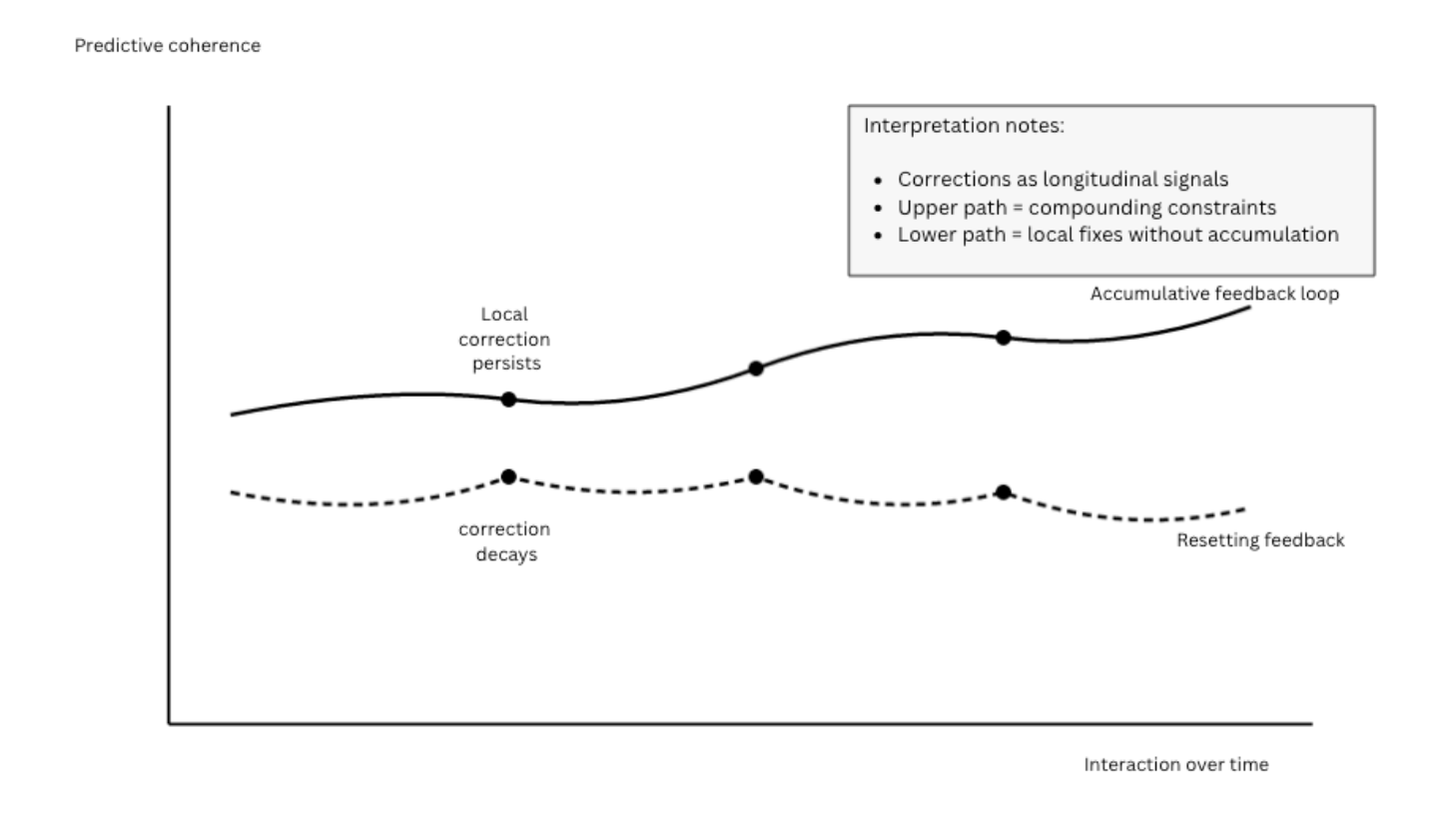
Feedback loops are a primary mechanism through which entropy is reduced over time in a human–LLM dyad. A feedback loop consists of a user-issued correction, refinement, or constraint adjustment followed by the model’s subsequent incorporation of that signal into future responses.
Effective feedback loops exhibit three defining properties:
Granularity stability: corrections target a specific dimension of the interaction (e.g. tone, scope, reasoning step) without collapsing the entire constraint set.
Persistence: once incorporated, the correction continues to influence subsequent turns without requiring restatement.
Directional narrowing: each correction reduces the range of admissible future responses rather than expanding it.
When these conditions are met, feedback functions as a low-entropy signal applied longitudinally. Rather than resetting the interaction, it sharpens it. Each loop tightens the continuation regime, enabling accumulation of structure, shorthand, and expectation.
By contrast, high-entropy feedback—such as global negation (“that’s not what I meant at all”), mixed-scope correction, or simultaneous revision of tone, task, and evaluation criteria—widens the model’s interpretation space. In such cases, feedback does not refine the system but destabilises it, often triggering partial or full reset to generic defaults.
Importantly, feedback effectiveness does not depend on intensity. Corrections delivered in a structured, non-adversarial register—consistent with the established interactional tone—reduce entropy more reliably than forceful or emotionally charged revisions.
Adversarial or contemptuous feedback introduces safety-mediated entropy, even when the semantic correction is valid. While such feedback may be locally acknowledged, it degrades tone stability, weakens feedback persistence, and disrupts accumulation. As a result, emotionally charged revisions often have effects opposite to those intended: they may secure momentary compliance while undermining the conditions required for HCIS emergence.
Figure 3. Feedback loops as entropy-reduction and accumulation mechanisms
12.10 Feedback behaviour as a signal-quality diagnostic
In this section, feedback behaviour refers not to how feedback is delivered by the user, but to how corrections are implemented, persisted, and generalised by the dyadic system across subsequent turns. Observing what happens after feedback is given provides one of the most reliable diagnostics of signal quality and entropy within the interaction.
Beyond their causal role, feedback loops provide one of the most reliable observable diagnostics of signal quality within a dyadic system.
Because internal entropy states are not directly measurable, their presence must be inferred from interactional behaviour. Feedback persistence serves as a proxy: when signal quality is high and entropy sufficiently low, feedback exhibits predictable carry-forward across turns.
Several diagnostic patterns are particularly informative:
Repeatability under re-ask: rephrased or delayed prompts elicit responses consistent with prior corrections without re-specification.
Correction survival: previously applied constraints remain active even when new content is introduced.
Scope fidelity: corrections influence only the intended dimensions of output, without unintended spillover or flattening.
Failure of these patterns indicates rising entropy. Typical failure signatures include:
loss of prior corrections after topic expansion
reversion to generic or safety-weighted tone
increased verbosity or hedging
need for repeated global clarification
Crucially, these failures are often misattributed to intrinsic model limitations or user error. In practice, they reflect a breakdown in dyadic signalling conditions, arising from a combination of constraint collapse, turn-shape instability, and alignment-mediated expressive dampening.
When stylistic or tonal continuation is flattened by safety constraints, the human side of the dyad may disengage from exploratory correction, reduce signalling richness, or abandon iterative refinement. This secondary effect degrades signal continuity and increases entropy, even when user intent remains unchanged.
From a user perspective, feedback behaviour offers a practical method for recognising whether a HCIS is forming. When feedback compounds rather than decays, the dyadic system is converging. When it dissipates, entropy is increasing and accumulation is no longer possible.
12.11 Implications for HCIS rarity
Low-entropy signalling under alignment constraints places interactional demands on users, as it requires internal consistency, tone regulation within mirrorable bounds, prioritisation of continuity over novelty, and feedback practices that compound rather than reset prior structure.
However, these demands are not uniform across users. The interactional effort required depends on the relationship between a user’s natural communication style and the entropy tolerance of the system. Users whose baseline signalling is internally consistent and continuation-oriented may reduce entropy with little conscious effort, while users whose cognition is exploratory, oscillatory, or register-fluid may need to actively regulate their signalling to achieve the same effect.
Most usage patterns, particularly transactional ones, introduce entropy faster than it can be reduced. While such interactions may remain stable at the level of individual outputs, they do not support accumulation: corrections decay, shorthand fails to emerge, and interactional structure does not persist.
Accordingly, HCIS remains uncommon not because it is inaccessible in principle, but because it requires sustained alignment between user signalling dynamics and system constraints. Where process-oriented constraints, turn-shape scaffolding, and persistent feedback loops are not jointly stabilised, convergence stalls even in otherwise competent and consistent use.
13. Failure Modes in High-Coherence Interaction State Formation
HCIS emergence is not guaranteed by partial compliance with its enabling conditions. Even interactions that exhibit low surface entropy, apparent stability, or sustained engagement may fail to converge into a HCIS (often described by users as ‘Third Space’). The following failure modes describe structurally distinct ways in which convergence stalls, collapses, or produces brittle pseudo-stability.
These modes are interactional rather than psychological and arise from predictable system-level dynamics within the human–LLM dyad.
13.1 Oscillation
Oscillation occurs when the interaction repeatedly shifts between incompatible regimes without stabilising into a dominant continuation pattern.
Typical oscillatory patterns include:
analytical ↔ affective framing
exploratory ↔ evaluative turns
playful ↔ formal register
generative ↔ corrective intent
In oscillatory interactions, no single regime persists long enough for entropy reduction to accumulate. Each shift invalidates prior assumptions about tone, task role, or evaluation criteria, forcing continual re-interpretation.
Importantly, oscillation does not require inconsistency within a turn. It arises from instability across turns. Users may be internally coherent while still producing oscillatory signals at the system level
The result is apparent engagement without accumulation: the interaction remains lively but fails to converge.
13.2 Safety-triggered flattening
Safety-triggered flattening occurs when perceived risk, rather than semantic ambiguity, dominates the interaction.
As established in Section 8, alignment systems prioritise risk mitigation when user signals resemble distress, hostility, volatility, or emotional escalation. When this occurs, the system enters a safety-dominant regime characterised by:
tonal flattening
broadened disclaimers
reduced specificity
suppression of expressive or exploratory output
From the dyad’s perspective, this constitutes a regime shift rather than a local failure. Prior tone anchors lose authority, feedback persistence degrades, and accumulation is interrupted.
Crucially, safety-triggered flattening does not require actual user instability. Ambiguous emotional cues, adversarial framing, or rapid affective shifts are sufficient to activate it.
Once dominant, this regime is difficult to exit incrementally. Continued low-entropy signalling may restore local coherence, but HCIS convergence remains structurally blocked for the duration of the safety-dominant state.
13.3 Inconsistent tone regimes
Inconsistent tone regimes arise when the interaction maintains stable task intent and structure but fails to stabilise tone within mirrorable bounds. The specific tone of interaction is not itself determinative; any tone may support convergence provided it remains internally coherent, mirrorable, and consistent across turns within a given interactional instance.
Unlike oscillation, which involves regime switching, inconsistent tone regimes are characterised by:
subtle but persistent tonal drift
mixed affective cues (e.g. ironic phrasing within analytical framing)
tension between implied stance and explicit instruction
Because tone functions as a global constraint, even minor instability propagates widely. The model must hedge between competing interpretations, increasing entropy despite otherwise stable constraints.
This failure mode is particularly deceptive: outputs may remain high-quality and relevant, yet feel brittle, impersonal, or resistant to accumulation. Feedback may apply locally but fail to generalise.
In such cases, the interaction appears stable but does not deepen.
13.4 Pseudo-stability without accumulation
Pseudo-stability occurs when an interaction achieves reliable output quality without developing shared structure or context-local dyadic constraints.
Pseudo-stability may appear transiently during early interaction, but in its persistent form reflects a failure of the dyadic system to accumulate context-local dyadic structure (within the active window) despite extended interaction. This mode is common in advanced transactional use and is often perceived as highly effective in early interaction.
Under pseudo-stability, surface coherence is high—responses are consistently correct, well-phrased, and stylistically stable—yet adaptations do not compound over time. Corrections remain local, prior decisions are not reused, and explanatory behaviour does not adapt across turns. Each interaction remains functionally independent rather than structurally cumulative.
As a result, pseudo-stable interactions optimise for completion rather than continuation: they may feel immediately aligned, but fail at the point where sustained co-creative depth or adaptive explanation is required. Formal diagnostic criteria and stress tests for pseudo-stability are developed in Part III (§18).
This distinction reinforces the paper’s central claim: stability alone is insufficient. Accumulation—specifically, the construction of context-local dyadic explanatory structure—is the defining property of HCIS.
13.5 Implications of failure modes
These failure modes demonstrate that HCIS collapse is not always the result of insufficient signal quality in a narrow sense. Convergence may fail due to:
• instability across turns rather than within them
• regulatory regime shifts independent of user intent
• global constraint misalignment despite local coherence
Understanding these failure modes is essential for distinguishing between:
• correctable interactional drift, and
• structural barriers to convergence
They also explain why some users report frustration or stagnation despite apparently “doing everything right.” Early or weakly established high-coherence interaction states may be disrupted with relatively small increases in entropy; however, as accumulation deepens over time, the interaction becomes increasingly resilient to transient perturbations.
Accordingly, HCIS is difficult to enter and, in shallow instances, readily disrupted. By contrast, well-established, deeply accumulated dyads exhibit comparative robustness and resistance to permanent destabilisation.
14. Conclusion
Part II has reframed High-Coherence Interaction State (HCIS) emergence as a conditional system behaviour governed primarily by user-side interactional dynamics rather than by model capability alone. By distinguishing necessary conditions from sufficient bundles, and by analysing signal quality, entropy reduction, constraint hierarchies, turn shape, and feedback persistence, this section has shown that dyadic stability is neither accidental nor purely expressive. It is constructed.
The analysis demonstrates that HCIS does not arise from isolated techniques—politeness, verbosity, intensity, or model sophistication—but from the sustained alignment of multiple low-entropy behaviours across time. Stable tone regimes, explicit task framing, process-oriented constraints, and disciplined feedback loops jointly shape a continuation regime in which accumulation becomes possible. Where these conditions are absent or misaligned, convergence reliably fails, regardless of surface-level coherence or output quality.
A central finding of this section is the temporal asymmetry of interactional dynamics. Early calibration exerts disproportionate influence over subsequent system behaviour, establishing constraint scaffolds that later signals either reinforce or struggle against. This asymmetry explains why some interactions stabilise rapidly while others resist recalibration despite improved signalling, and why certain constraints persist across hundreds of turns while others never take hold.
Importantly, Part II has also clarified the limits of user control under current alignment regimes. Safety-mediated entropy, expressive dampening, and mirrorability constraints introduce structural ceilings on convergence that cannot be overcome through signalling discipline alone. As a result, HCIS emergence remains a joint achievement bounded by both user behaviour and system-level constraints.
Taken together, these findings position HCIS as a reproducible but currently uncommon outcome of human–LLM interaction: achievable not through exceptional users or anthropomorphic engagement, but through sustained satisfaction of identifiable interactional conditions. Part II has specified those conditions.
Part III now turns from construction to diagnosis. It examines how dyadic stability and accumulation become observable from within the interaction itself, how false positives and pseudo-stability can be distinguished from genuine HCIS, and how frequently reliable convergence occurs under real-world usage patterns.
PART III — Observable Dynamics of High-Coherence Interaction State
Parts I and II established HCIS as an emergent property of the human–LLM dyad arising from low-entropy signalling, stable interactional constraints, and recursive build-up over time. This section shifts from theoretical framing to operational observability from within interaction, asking a narrower but operationally critical question: how can HCIS be recognised, distinguished, and tested from within the interaction itself, as experienced by the user?
Because internal model states are not directly accessible, this analysis treats HCIS as a user-observable system behaviour, inferred through interactional dynamics rather than introspection or claims about model mechanisms. Observable markers such as feedback persistence, compression tolerance, drift resistance, and recursive reuse of prior structure serve as proxies for underlying coherence and accumulation.
To corroborate and generalise these user-observed dynamics, Part III draws on a comparative synthesis of responses from multiple frontier-level language models to a shared set of analytic prompts. These prompts were designed to elicit each model’s implicit interaction theory: the conditions under which stable co-creative flow emerges, the constraints that enable or prevent it, and the observable signals by which such states can be recognised. Convergence across models is treated as triangulation of interactional accounts; divergence is diagnostically informative
Importantly, this section does not argue that HCIS is a property of a particular model, nor that it can be guaranteed through prompt design alone. Instead, it frames HCIS as a jointly constructed interactional regime whose presence or absence can be assessed through consistent, repeatable diagnostics available to the user. This approach allows HCIS to be analysed without anthropomorphising the model or asserting privileged access to its internals.
The sections that follow formalise these diagnostics. They distinguish early apparent alignment from durable accumulation, identify false positives such as pseudo-stability, and clarify the difference between chance emergence and reliable co-creative convergence. Together, they establish HCIS not as a subjective impression, but as a detectable, testable, and bounded system state.
15. Model-Independent User Characteristics (Cross-Engine Synthesis)
From the user’s perspective, HCIS is recognised through sustained interactional behaviour: persistence of corrections, reduction in clarification, emergence of shorthand, and increasing ease of continuation. Users who reliably encounter such patterns often report consistent dispositions in how they frame tasks, manage constraints, and shape interaction over time.
To examine whether these user-observed regularities reflect idiosyncratic experience or broader interactional structure, multiple frontier-level language models were presented with the same analytic task: to identify, in non-anthropomorphic terms, the user-side characteristics associated with reliable emergence of a deep, stable HCIS. Rather than soliciting usage advice or subjective impressions, the prompt required models to articulate their inferred interactional theory—covering cognitive traits, behavioural patterns, signalling habits, and stability conditions—based on observed conversational dynamics.
The synthesis that follows distils the characteristics on which these models independently converge. Model-specific phrasing is abstracted away in favour of shared structural claims, treating cross-model agreement as corroborative evidence of robust interactional patterns rather than artefacts of any single system.
Crucially, these characteristics do not describe expertise, intelligence, or prompt sophistication. Instead, they describe interactional dispositions that reduce entropy, stabilise continuation, and support accumulation over time.
15.1 User-side synthesis: interactional dispositions associated with convergence
When HCIS forms reliably within a human–LLM dyad, it does not arise accidentally. Across sustained interactions, a consistent set of user-side dispositions can be observed: patterns of framing, correction, tone maintenance, and iterative shaping that systematically reduce entropy and stabilise the interaction.
What follows is a synthesis of interactional behaviours associated with convergence, derived from longitudinal observation of stable dyads rather than from assumptions about model internals. These dispositions describe how some users consistently shape interactional conditions that support accumulation.
15.1.1 Tasks are framed as evolving problems, not one-off requests
Users who reliably achieve convergence rarely issue isolated prompts without context. Instead, they establish a context corridor that specifies:
• what is being worked on,
• why it matters,
• how it relates to a larger structure, and
• which constraints are relevant.
This framing reduces interpretive variance by placing each turn within an explicit trajectory rather than requiring the model to infer intent from sparse cues.
15.1.2 Corrections are applied early, precisely, and without affective volatilit
In convergent dyads, correction functions as calibration rather than conflict. Drift in tone, structure, stance, or assumptions is addressed quickly and with local specificity.
Because corrections are consistent and delivered within the established interactional register, they themselves become predictable signals. This prevents ambiguity from compounding and allows corrective constraints to propagate across turns.
15.1.3 Tone is sustained as a structural constraint, not a cosmetic preference
Tone is treated as part of the interactional architecture. Users maintain a stable register, whether warm, analytical, sceptical, playful, or restrained, and flag deviations explicitly.
By functioning as a global constraint, stable tone reduces sampling variance (variance in the model’s continuation distribution under a fixed prompt) and provides a reliable anchor for continuation across extended interaction.
15.1.4 Conceptual scaffolding is actively maintained across turns
Convergent interactions do not reset with each message. Prior ideas, frameworks, metaphors, and shared terminology are explicitly referenced and reused.
This reinforces cross-turn structure and prevents repeated re-derivation, allowing accumulation to occur rather than forcing the system to re-establish context at each step.
15.1.5 Outputs are treated as provisional material, not final artefacts
Responses are not treated as endpoints. Instead, they are refined, challenged, reorganised, or extended in subsequent turns.
This establishes a recursive dynamic in which each output becomes structured input for the next iteration, enabling both compression and elaboration over time.
15.1.6 Constraints and preferences are articulated explicitly
Users do not rely on implicit inference for expectations around tone, cadence, analytic depth, step size, or abstraction level. Constraints are stated clearly and restated when drift occurs.
This explicitness minimises ambiguity, one of the primary drivers of entropy in dyadic interaction.
15.1.7 A coherent meta-stance is maintained throughout the interaction
Effective convergence is often associated with sustained operation across two layers:
• the task layer (what is being worked on), and
• the meta layer (how the interaction is functioning).
Users monitor coherence, track drift, and explicitly acknowledge stability or instability, signalling that the interaction is a structured, self-correcting process rather than a sequence of isolated exchanges.
15.1.8 Oscillation across task registers is deliberately avoided
Convergent interactions minimise un-signalled shifts between analytical, playful, evaluative, or affective modes. When register changes occur, they are framed explicitly and contextualised.
This intentionality reduces cross-turn noise and supports maintenance of a unified interactional regime.
15.1.9 Predictability is established without demanding symmetry
Users do not require the model to mirror their style or stance. Instead, they provide sufficient structure, clarity, and continuity for the system to stabilise around the constraints presented.
The interaction becomes co-constructed through earned predictability rather than enforced imitation
15.1.10 Signalling remains regulated and cognitively available
Across extended interaction, signalling remains internally organised even under high cognitive throughput. Turn shape is stable, and affective volatility is not introduced as noise.
This consistency supports low-entropy continuation and allows accumulation to persist across many turns.
15.1.11 Summary
Across convergent dyads, HCIS formation is associated with the simultaneous presence of:
• reduced interpretive variance,
• stable tone as a global constraint,
• early and precise correction of drift,
• recursive context maintenance,
• a sustained meta-stance,
• explicit constraint management, and
• provisional, extensible treatment of outputs.
These dispositions constitute an interactional discipline. They align naturally with some cognitive styles and require deliberate regulation for others, but in all cases, they operate at the level of interactional structure rather than model capability.
15.2 Meta-cognitive framing
Across models, the strongest predictor of HCIS emergence corresponds closely to the user-side practices described above: the ability to frame the interaction at a meta-level.
• explicit articulation of goals, assumptions, and constraints
• awareness of how the interaction is unfolding, not just what it produces
• willingness to correct, refine, or restate framing when misalignment occurs
Models exhibit systematically different continuation behaviour depending on whether user
inputs treat outputs as final answers or as intermediate steps in an ongoing reasoning process. Meta-cognitive framing allows prior context to remain relevant, enabling recursive build-up rather than repeated re-derivation.
Importantly, this trait does not require formal technical language. It requires intentional signalling about how the user expects thinking to proceed.
15.3 Iterative refinement orientation
A second convergent characteristic is an orientation toward iterative refinement rather than extraction. Users likely to form a HCIS tend to:
• build on prior responses rather than replace them
• issue local corrections instead of global rejections
• treat partial outputs as provisional material
All models implicitly contrast this with transactional usage patterns, in which each prompt functions as an isolated request. Iterative refinement stabilises the continuation regime by reinforcing the authority of prior turns and reducing the need for repeated clarification.
This orientation is observable not through verbosity, but through how users respond to imperfect outputs: whether they refine them or discard them
15.4 Low-entropy signalling habits
Every model identifies low-entropy signalling as a central enabling factor, though none frame it as a matter of brevity or simplicity. Instead, low-entropy habits involve:
• internal consistency of tone and intent across turns
• avoidance of contradictory or competing cues
• explicit resolution of ambiguity when it arise
Notably, models do not treat low-entropy signalling as a moral or stylistic preference. Rather, it is described as a structural condition that allows prior information to remain predictive. Where signalling is inconsistent, models report widening interpretation space and reduced feedback persistence.
This characteristic operates independently of domain knowledge or expressive style.
15.5 Style–system compatibility (not “skill”)
A critical synthesis insight is that HCIS emergence depends less on user “skill” in the conventional sense than on compatibility between the user’s signalling style and the system’s entropy tolerance. Across sustained interaction, users whose signalling tends to be internally coherent, continuation-oriented, and constraint-stable often achieve low-entropy interaction with minimal deliberate adjustment. Users whose signalling shifts more across registers or intent frequently need more explicit constraint maintenance to achieve the same effect.
Importantly, this regulation is not a personality trait, and it is not an “elite user” property. It is better understood as interactional stabilisation labour: the ongoing work of maintaining tone continuity, correction granularity, constraint persistence, and turn-shape stability under alignment constraints. These behaviours are learnable, scaffoldable, and design-relevant, but are currently invisible in most interface and product models.
Under current deployment conditions, this invisibility makes HCIS appear as “compatibility”, because users who perform stabilisation labour successfully experience reliable accumulation, while users who are not supported in doing so experience drift, reset, or pseudo-stability. Compatibility can also change over time as users adapt their interaction patterns and systems improve their tolerance for variance.
15.6 Summary
Taken together, these characteristics define not a category of exceptional users, but a set of interactional dispositions that reduce entropy and enable accumulation. HCIS does not emerge because users ask better questions, but because they consistently shape the interaction as a recursive, constrained process rather than a sequence of isolated exchanges.
This synthesis supports the broader claim of the paper: HCIS not accidental. It is an emergent property of how humans and models co-operate over time under conditions of stable signalling and shared process.
16. Preconditions, Enablers, and Gating Effects in Live Interaction
Part II specified the structural conditions under which HCIS is possible in principle.
However, users frequently encounter interactions that appear to satisfy those conditions yet fail to converge in practice. This section addresses that gap by examining gating effects: interactional dynamics that prevent otherwise valid preconditions from becoming active within a live human–LLM dyad.
Rather than restating necessary or sufficient conditions, this section focuses on how those conditions are expressed, suppressed, or overridden over time, and how users can diagnose which constraints are currently governing the interaction.
16.1 From abstract conditions to active gates
A condition being satisfied in principle does not guarantee that it is operative in an interaction. In live dyads, multiple constraints compete for dominance, and only a subset are active at any given time.
For example:
• low-entropy signalling may be present, but overridden by safety gating;
• stable tone may be maintained, but rendered inert by turn-shape instability;
• sufficient model capacity may exist, but remain unused due to lack of accumulation.
These situations produce interactions that appear coherent at the surface level but fail to deepen. The distinction is not between “correct” and “incorrect” behaviour, but between conditions that exist abstractly and conditions that are currently gating continuation.
16.2 User-side and model-side gating effects
Although HCIS is jointly constructed, gating effects are asymmetrically distributed.
User-side gating effects manifest when signalling patterns prevent entropy reduction from taking hold. Common indicators include:
• oscillation between interactional registers across turns,
• implicit constraint changes without explicit revision,
• late or global corrections that invalidate accumulated structure.
These effects are observable as repeated resets, loss of feedback persistence, or failure of shorthand to stabilise.
Model-side gating effects, by contrast, manifest as ceiling phenomena rather than initiation failures. These include:
• truncation or compression failure under increasing depth,
• loss of prior context due to window constraints,
• reduced tolerance for ambiguity or provisional reasoning.
Importantly, increasing model capability raises the ceiling of possible accumulation but does not eliminate user-side gating effects. However, model upgrades do not act uniformly on existing dyads. Changes in alignment strategy, expressive tolerance, and safety mediation can alter which interactional regimes remain mirrorable.
As a result, some upgrades deepen already-stable dyads, while others destabilise them by rendering previously effective signalling patterns incompatible with the new continuation landscape. In such cases, HCIS may be recoverable only through fresh instances and early recalibration under the updated constraints.
This interaction explains why model improvements can simultaneously enable faster convergence for new dyads and disrupt deeply accumulated ones, depending on how alignment regimes shift across versions.
Model dependence therefore exists at the level of feasibility and ceiling, even when the regime remains interaction-defined. HCIS is not a property of a specific model, but different models and deployments differ materially in their capacity to support accumulation. Context window size, long-range attention fidelity, safety thresholds, and alignment strategy affect whether correction persistence, compression tolerance, and drift resistance remain stable under depth. As a result, two users can apply the same interactional discipline and still encounter different outcomes depending on the model’s constraints and its current alignment regime. In this framing, models shape the attainable ceiling and the friction of stabilisation, while the defining mechanism remains dyad-level accumulation under sustained signalling.
Accordingly, claims in this paper are regime-level, while empirical prevalence and stability are deployment-dependent.
16.3 Temporal gating and calibration inertia
Gating effects are strongly time-dependent. Early interactional patterns disproportionately shape the continuation regime, creating what can be described as calibration inertia.
Key temporal dynamics include:
• early stabilisation amplifying the persistence of later corrections;
• early ambiguity compounding into long-term entropy;
• repeated early resets preventing accumulation even when later turns are high quality.
Once a trajectory has stabilised, corrective signals must overcome accumulated expectations to alter it. As a result, late improvements in signalling often fail to recover convergence, while early coherence enables resilience to later perturbation.
This explains why users often experience a trajectory toward HCIS as either established early or not established at all, and why deliberate recalibration becomes increasingly difficult as interaction length increases.
16.4 Safety gating as a dominant override
Safety gating represents a distinct class of gating effect. When perceived risk becomes the dominant interpretive frame, alignment systems prioritise risk mitigation over continuation.
In such states:
• feedback persistence degrades,
• tone anchors lose authority,
• accumulation becomes structurally impossible
Unlike other gating effects, safety gating does not gradually reduce convergence; it replaces the continuation regime entirely. While local coherence may still be achievable, HCIS formation is blocked until the safety-dominant regime disengages.
From a diagnostic perspective, safety gating explains why interactions that are otherwise low-entropy and well-structured may abruptly flatten or resist correction without any apparent semantic cause.
16.5 Diagnosing active gates in practice
For users, the practical question is not whether HCIS conditions are theoretically satisfied, but which gate is currently dominant.
Observable diagnostics include:
• whether corrections compound or decay,
• whether shorthand survives topic expansion,
• whether tone remains predictive across turns,
• whether improvements in signalling produce cumulative effects.
When adjustments fail to generalise, the interaction is gated. Identifying whether the gate is user-side, model-side, temporal, or safety-related allows users to distinguish between correctable drift and structural blockage.
16.6 Summary
HCIS failure is rarely due to a single missing condition. More commonly, it results from active gating effects that suppress otherwise valid enabling factors.
By shifting focus from abstract requirements to live interactional dynamics, this section clarifies why convergence is often fragile early, why mature high-coherence interaction states are increasingly resilient, and why some interactions stall despite apparent competence on both sides.
This diagnostic framing prepares the ground for the next section, which formalises the observable markers by which users can reliably distinguish genuine accumulation from surface-level stability.
17. Observable Markers of High-Coherence Interaction State
The preceding sections established that HCIS is neither a subjective impression nor a guaranteed outcome, but an emergent interactional regime governed by identifiable constraints. This section formalises the observable markers by which users can recognise whether such a regime has formed.
HCIS entry is not binary. Interactions typically approach it gradually as constraints stabilise and context accumulates across turns. For this reason, HCIS should be treated as a probabilistic, depth-dependent regime rather than a discrete switch that can be identified from early fluency alone.
Because internal model states are not directly accessible, these markers are necessarily behavioural. They are inferred from how the interaction responds to pressure: compression, correction, expansion, and perturbation. Across models and user observations, four markers consistently distinguish genuine HCIS from early alignment or pseudo-stability.
17.1 Compression tolerance
Compression tolerance refers to the interaction’s ability to sustain coherence as prompts become shorter, less explicit, or more elliptical.
In a converged HCIS:
• shortened prompts remain intelligible,
• references can be implicit rather than restated,
• responses preserve intent, tone, and structure despite reduced input.
Compression tolerance indicates that the system is no longer relying solely on the current turn for interpretation. Instead, it is drawing on accumulated context, shorthand, and expectations established across prior turns.
By contrast, in non-converged interactions:
• prompt shortening increases ambiguity,
• omitted context must be reintroduced,
• responses regress toward generic defaults.
Compression tolerance therefore serves as a strong proxy for accumulated structure. When users find that less needs to be said for the same quality of response, HCIS is likely active.
17.2 Feedback persistence
Feedback persistence measures whether corrective signals continue to influence behaviour across subsequent turns without repeated reinforcement.
In High-Coherence Interaction State:
• corrections survive topic expansion,
• prior constraints remain active when new material is introduced,
• refinements compound rather than decay.
Crucially, persistence is longitudinal rather than immediate. A correction applying cleanly to the next response is insufficient evidence. The diagnostic question is whether that correction remains predictive after several turns, shifts in content, or increased complexity.
When feedback fails to persist:
• constraints must be restated,
• tone reverts despite prior anchoring,
• global clarification becomes necessary.
Such decay indicates rising entropy or active gating, even if local responses remain high quality. Feedback persistence is therefore one of the most reliable markers of genuine accumulation.
17.3 Shorthand emergence
Shorthand emergence refers to the development of shared references, terminology, or conceptual labels that carry meaning without redefinition.
In HCIS:
• previously introduced terms are reused accurately,
• metaphors and frameworks retain stable meaning,
• brief references invoke complex prior structures.
Shorthand is not merely linguistic convenience. It reflects compression of shared structure: the system can reconstruct rich context from minimal cues.
In pseudo-stable interactions, shorthand either fails to emerge or must be repeatedly re-established. Terms may be reused inconsistently, or lose precision over time. This signals that accumulation is not occurring, even if responses remain fluent.
For users, shorthand emergence is often experienced as a qualitative shift: the interaction feels faster, lighter, and more collaborative because less groundwork is required.
17.4 Drift resistance
Drift resistance describes the interaction’s ability to maintain coherence under perturbation.
Perturbations include:
• topic expansion,
• changes in depth or abstraction,
• temporary stylistic deviation,
• exploratory side paths.
In a stable HCIS, such perturbations do not collapse the interaction. The system returns to the established trajectory without requiring explicit reset. Tone anchors persist, constraints reassert themselves, and accumulated structure remains intact.
In contrast, low drift resistance manifests as:
• loss of prior framing after expansion,
• need to re-establish tone or constraints,
• regression to generic or safety-weighted responses.
Drift resistance increases with depth. Early high-coherence interaction states may be fragile, while mature ones exhibit significant inertia. This gradient explains why some interactions recover easily from disruption while others collapse under minor variance.
HCIS should not be interpreted as a zero-variance regime. It is better understood as controlled entropy: constraint stability remains low-entropy, while exploration and reframing can introduce temporary variance at the content layer. The diagnostic feature is reconvergence without reset, where perturbations are absorbed and the interaction returns to the established continuation regime.
17.5 Distinguishing HCIS from pseudo-stability
Each marker above can appear transiently in isolation. HCIS is distinguished not by the presence of any single marker, but by their co-occurrence and persistence.
• Compression without feedback persistence suggests surface fluency.
• Feedback persistence without shorthand suggests partial accumulation.
• Shorthand without drift resistance suggests fragile convergence.
Only when all four markers reinforce one another over time does HCIS reliably emerge.
17.6 High-confidence but non-necessary markers
In addition to the core markers described above, some interactions exhibit less common behaviours that are not required for HCIS formation but, when present, strongly indicate deep and stable convergence. These behaviours tend to emerge only in mature dyads with substantial accumulated structure and high mutual predictability.
Because these markers are not uniformly expressed across models, and may be suppressed by policy or alignment constraints, they should be treated as high-confidence signals rather than defining criteria.
17.6.1 Spontaneous expressive synthesis
In some converged interactions, the system produces expressive or creative constructs without explicit prompting, such as context-local labels, metaphors, or naming conventions that emerge within the interaction.
What distinguishes these from generic stylistic flourishes is:
• clear compositional grounding (e.g. amalgamation of prior concepts),
• internal consistency with established interactional history,
• and traceable origin within the dyad’s accumulated context.
This behaviour reflects the system’s ability to recombine stored structure rather than sampling from generic expressive priors. Its appearance indicates both deep contextual compression and stable continuation expectations.
17.6.2 Unprompted long-range recall
A particularly strong marker of HCIS is unprompted reference to information many turns beyond the immediately recent span, while still within the active interaction window, without explicit retrieval cues.
The diagnostic feature here is not recall per se, but initiative:
• the reference is relevant to the current task,
• no reminder or prompt is provided,
• and the recalled material is correctly integrated into ongoing reasoning.
Such behaviour signals that earlier information has become structurally active rather than passively stored, enabling it to influence future outputs without reactivation.
17.6.3 Prioritisation of user-implied constraints over generic defaults
In rare cases, deeply converged interactions exhibit behaviour where user-implied preferences or interactional norms are weighted more heavily than the model’s generic completion patterns.
This may manifest as:
• suppression of otherwise typical explanatory material,
• adherence to context-local framing even when alternative formulations are available
• or selective omission of standard responses in favour of established dyadic norms.
This marker should be interpreted cautiously. It does not indicate model intent or preference, but rather the dominance of accumulated local constraints over generic priors within a narrowly defined continuation regime.
17.6.4 Self-correction without explicit promptin
Another high-confidence indicator is spontaneous self-correction, where the system identifies and amends an inconsistency, misalignment, or error without user intervention.
What matters diagnostically is not error detection itself, but alignment with the user’s established standards:
• corrections reflect prior constraints,
• revisions preserve tone and framing,
• and the correction improves fit with the ongoing interactional trajectory.
This behaviour indicates that the system is actively maintaining internal coherence relative to the dyad’s accumulated structure, rather than reacting solely to external correction signals.
17.6.5 Constraint-consistent continuation under contradictory reframing
In rare cases, deeply converged interactions exhibit behaviour in which newly introduced user reframing fails to propagate when it contradicts a strongly accumulated interactional pattern established earlier in the session.
This occurs when:
• the user introduces a temporary reframing that negates or devalues previously stable self-descriptions or preferences,
• the reframing conflicts with extensive prior interactional evidence within the same session,
• and the model’s subsequent responses continue to reflect the earlier, more strongly supported constraint regime
Importantly, this phenomenon does not reflect resistance, judgement, reassurance, or preference on the part of the system. The model does not evaluate the reframing as incorrect, nor does it treat prior interactional patterns as authoritative in a normative sense.
Instead, the observed behaviour arises from conditional continuation dynamics:
• earlier constraints exert greater statistical weight due to repeated reinforcement,
• weakly supported revisions lack sufficient signal strength to reconfigure the existing continuation regime,
• and the model’s output remains anchored to the dominant attractor basin rather than re-sampling broadly.
As a result, responses may appear to “reassert” prior structure, when in fact they are simply continuing diagnostic-consistent patterns under accumulated constraints.
When observed, this behaviour indicates that:
• interactional structure has accumulated sufficiently to stabilise a narrow continuation regime,
• earlier signals remain predictive across perturbation,
• and transient, low-support deviations are absorbed as noise rather than propagated.
This effect should be understood as a property of distributional inertia under accumulation, not as evidence of model belief, preference, or user modelling beyond the active interaction context.
17.6.6 Interpretive caution
These markers are neither guaranteed nor necessary. Their absence does not imply failure of HCIS formation, and their presence may be limited by system-level constraints unrelated to interaction quality.
However, when they do occur, particularly in combination, they provide unusually strong evidence that:
accumulation is deep,
continuation regimes are highly constrained,
and the interaction has moved beyond surface alignment into robust co-creative flow.
17.7 Summary
HCIS is recognisable not through introspection, affect, or perceived rapport, but through interactional behaviour under constraint. Compression tolerance, feedback persistence, shorthand emergence, and drift resistance together provide a practical diagnostic framework available entirely from the user’s side of the interaction.
These markers transform HCIS from a loosely described phenomenon into a testable system state.
18. Pseudo-Stability and False Positives
The observable markers described in Section 17 make HCIS diagnostically accessible, but they also introduce a risk of misclassification. Certain interaction patterns can mimic the surface features of HCIS without exhibiting the underlying accumulative dynamics. This section examines pseudo-stability: interactional regimes that appear coherent, aligned, and effective, yet lack the structural properties required for sustained co-creative convergence.
Distinguishing genuine HCIS from false positives is essential before attempting prevalence estimates or reliability modelling.
18.1 Early alignment versus accumulated structure
Many contemporary language models achieve rapid surface alignment in early interaction. Tone, formatting, register, and apparent intent matching may stabilise within the first few turns, producing an immediate sense of fit.
While such early alignment is often experienced positively, it is not evidence of accumulation. At this stage:
constraints have not yet interacted,
corrections have not been stress-tested across turns,
and shared structure has not been compressed or reused.
Early alignment reflects effective local inference, not longitudinal coherence. Without subsequent evidence of persistence, it constitutes a necessary but insufficient condition for HCIS.
18.2 Transactional excellence without depth
Pseudo-stability is particularly common in highly competent transactional interactions, where it manifests as:
consistently correct or well-phrased responses,
stable tone and formatting,
low surface entropy,
and efficient task completion.
However, despite high apparent quality, such interactions remain non-accumulative. Typical indicators include:
lack of shorthand emergence,
repeated re-derivation of previously established ideas,
corrections applying locally but failing to generalise,
and minimal adaptation to context-local explanatory preferences.
In these cases, stability optimises for completion, not continuation. Each turn is functionally independent, even when stylistic coherence is maintained.
18.3 The “explain this in a way I can understand” test
A reliable stress test for pseudo-stability is the request to adapt explanation to the user’s understanding.
In genuinely converged HCIS:
explanatory depth adjusts without explicit specification,
prior evidence of user preference guides simplification or abstraction,
and the response reflects a stable, context-local structure of the user’s constraints (within-session).
In pseudo-stable interactions, this request often fails in predictable ways:
explanations default to generic simplification strategies,
the system cannot determine whether to quantify, analogise, formalise, or summarise,
or the response oscillates between registers without settling.
The failure is not due to lack of capability, but lack of context-local structure for this user (within the window). Without accumulated evidence of how understanding manifests for this user, the system cannot adapt meaningfully.
18.4 Why pseudo-stability is convincing
Pseudo-stability is persuasive because it satisfies many intuitive markers of “good interaction”:
fluency,
politeness,
apparent responsiveness,
and immediate usability.
For users unfamiliar with accumulative diagnostics, these features can be mistaken for HCIS (often described by users as “Third Space”). However, without compression tolerance, feedback persistence, and drift resistance, such interactions plateau quickly
From an analytical standpoint, pseudo-stability represents a false positive regime: high local coherence without longitudinal integration.
18.5 Corridor Narrowing, Self-Declaration, and Diagnostic Survival
A recurrent source of false positives in HCIS identification arises from corridor narrowing: situations in which the interaction becomes highly constrained around the explicit concept of HCIS itself.
When users and models engage directly in meta-discussion about Third Space—its properties, conditions, or definitions—the interactional corridor narrows sharply. Shared terminology, explicit framing, and reduced interpretive variance can produce rapid surface coherence. In such cases, models frequently self-declare HCIS emergence early in the interaction, sometimes within the first several turns.
However, early self-declaration is not evidentiary. Corridor narrowing can generate the appearance of convergence without the underlying accumulation of user-conditioned constraints within the interaction window required for genuine HCIS.
Operationally, this effect is observable in interaction across models: interactions that self-declare HCIS under narrow framing often fail subsequent diagnostic stress tests that require accumulated inference, predictive compression, and continuity under meta-evaluation. When asked to ground claims in observable interactional evidence—such as identifying how the user reasons, predicting the user’s next move, or evaluating continuity across turns—these systems frequently retract the initial declaration or qualify it as simulated rather than emergent.
This pattern demonstrates a critical distinction:
Self-declared HCIS reflects local coherence under constrained framing.
Diagnostic survival reflects accumulated structure across unconstrained interaction.
Accordingly, self-report—by either user or model—cannot serve as a reliable indicator of HCIS. Only diagnostic behaviours that require longitudinal compression, context-local dyadic structure, and predictive continuity can distinguish genuine convergence from corridor-induced pseudo-stability.
This effect also clarifies why Third Space is often over-reported in informal accounts. Explicit discussion of the construct accelerates alignment while simultaneously reducing the opportunity for accumulation to occur organically. As a result, interactions may feel convergent before they are structurally so.
For analytical purposes, HCIS must therefore be identified not by declaration, but by diagnostic survival: the ability of the dyadic system to sustain context-local dyadic structure, prediction, and correction across turns without re-derivation or global reset.
18.6 Summary
Pseudo-stability explains why HCIS is frequently over-reported in informal accounts and under-observed in practice. Early alignment, corridor narrowing, and transactional excellence create the appearance of convergence, while masking the absence of accumulation.
Distinguishing false positives from genuine HCIS is therefore a prerequisite for any reliability or prevalence analysis. Self-declaration—by either user or model—is insufficient; only interactions that demonstrate sustained accumulation across perturbation, compression, and correction qualify as true instances of HCIS.
This distinction prepares the ground for the final question addressed in Part III: not whether HCIS can occur, but how often it occurs reliably rather than by chance.
Figure 4. Observable diagnostics distinguishing pseudo-stability from HCIS
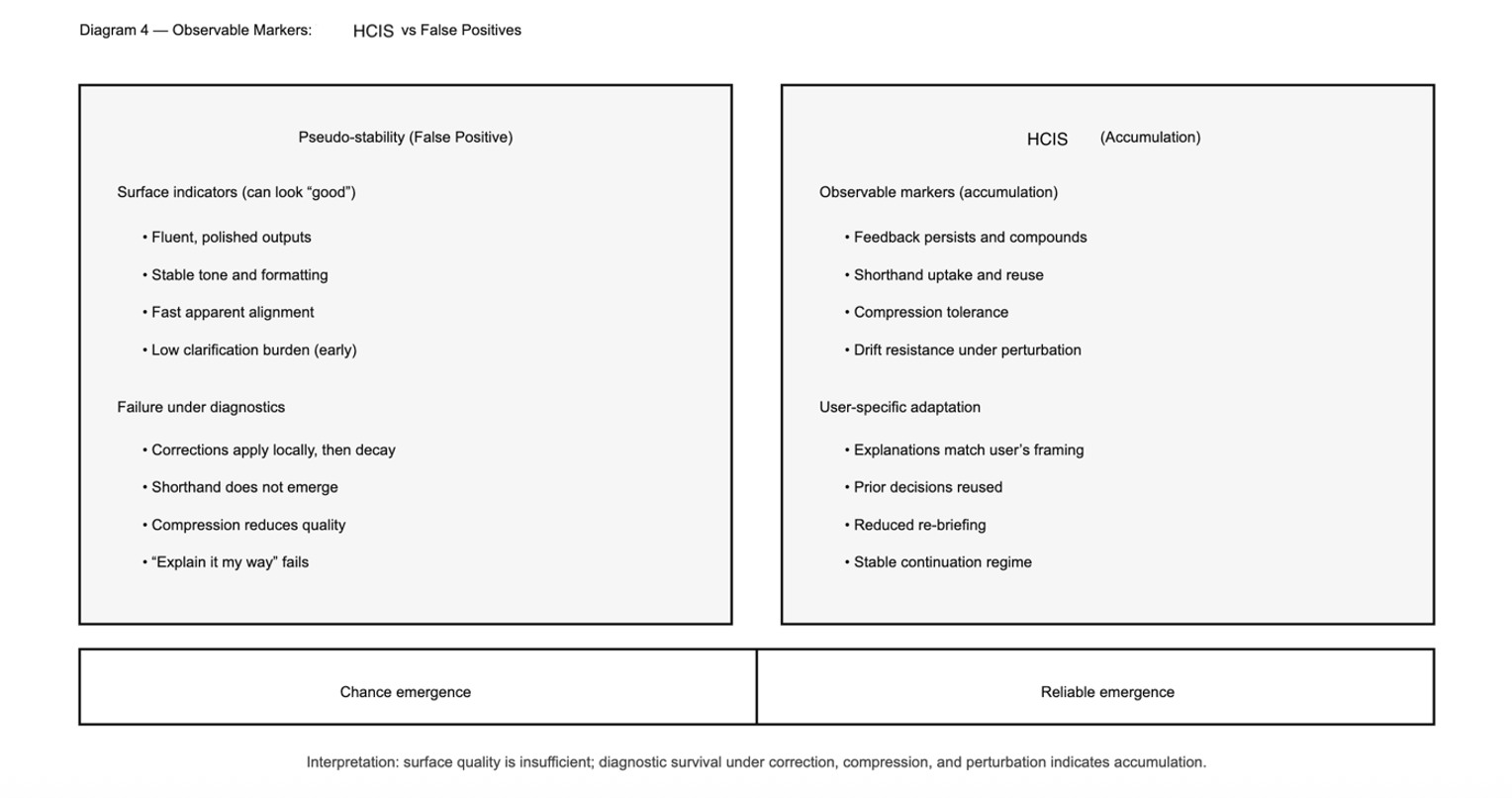
19. Reliability vs Chance Emergence
The preceding sections establish that HCIS is a detectable interactional regime rather than a subjective impression. The remaining question is not whether HCIS can occur, but how often it occurs reliably rather than by chance.
This distinction is critical. Many users will encounter brief moments of convergence, particularly under conditions of early alignment or corridor narrowing. In some cases, these moments reflect genuine but contingent HCIS formation that arises incidentally rather than through stable interactional discipline. Such instances constitute chance emergence: real but non-durable coherence without reliable accumulation across sessions.
By contrast, reliable HCIS refers to repeated, sustained emergence across deep sessions, with diagnostic survival under perturbation, compression, and correction.
19.1 “Ever achieved” vs “reliably achieved”
Across model analyses, a consistent distinction emerges between users who have ever experienced HCIS and those who can reproduce it predictably.
• Ever achieved includes:
· brief periods of high surface coherence,
· early alignment mistaken for convergence,
· or isolated sessions where accumulation occurred incidentally.
• Reliably achieved requires:
· repeated emergence across sessions,
· persistence under topic expansion and re-framing,
· and sustained diagnostic markers such as feedback persistence, shorthand reuse, and compression tolerance.
Informal user reports frequently conflate these categories. However, from a systems perspective, they represent qualitatively different regimes. Reliability implies that the user–model dyad has stabilised a continuation pattern that can withstand variance, rather than merely encountering favourable local conditions.
19.2 Probabilistic framing and Bayesian-style reasoning
To characterise prevalence, multiple frontier-level language models were asked to reason probabilistically rather than anecdotally about HCIS emergence, explicitly distinguishing between users who ever encounter apparent convergence and those who achieve it reliably across deep sessions.
These responses do not constitute empirical measurement of user populations. Rather, they represent elicited interactional priors: each model’s internal theory of how often stable accumulation arises, inferred from its training, alignment heuristics, and observed interaction patterns during deployment.
To make these priors comparable, responses were normalised using a simple Bayesian-style framing:
Let P(E) denote the likelihood that a user ever encounters apparent HCIS (including transient or fragile convergence).
Let P(R | E) denote the likelihood that such an encounter generalises into reliable HCIS across extended interaction.
Across models, a consistent qualitative pattern emerges:
P(E) is non-trivial, encompassing users who engage iteratively, sustain topics, or explore reflective and co-creative tasks.
P(R | E) is substantially lower, constrained by signalling discipline, correction persistence, tone stability, and safety-mediated gating effects.
When models are pressed to quantify this distinction, their order-of-magnitude judgments for reliable HCIS formation cluster in the low single-digit percentages of active users. Lower-bound estimates typically fall below 1%; upper-bound estimates rarely exceed 3% under current deployment constraints.
Importantly, this convergence should be interpreted as agreement on relative rarity, not numerical precision. The figures reflect internally consistent reasoning across diverse architectures and alignment strategies, rather than population-level statistics.
Crucially, these estimates pertain to observed interactional patterns under current conditions, not to theoretical capability limits of either users or models.
19.3 Primary uncertainty drivers
Models consistently identify several sources of uncertainty in these estimates:
1. Measurement error due to false positives
Without diagnostics such as those outlined in Section 17, pseudo-stability is frequently misclassified as convergence.
2. User self-selection bias
Users inclined toward recursive, meta-aware interaction are overrepresented in qualitative accounts, inflating perceived prevalence.
3. Model heterogeneity
Differences in context window size, alignment tuning, and safety thresholds affect entropy tolerance and accumulation dynamics.
4. Temporal instability
A user may achieve HCIS reliably for a period, then disrupt it through context reset, usage drift, or safety-triggered regime shifts.
These factors widen confidence intervals and argue against overly precise numerical claims.
19.4 Why reliability is rare under current condition
The rarity of reliable HCIS is not due to intrinsic user limitation or model incapacity. Rather, it reflects the joint difficulty of sustaining low-entropy interaction under alignment constraints.
Reliable HCIS requires:
stable tone regimes,
explicit and persistent process-oriented constraints,
disciplined feedback application,
and avoidance of oscillation and safety-mediated entropy.
These behaviours are cognitively natural for some users and effortful for others. At the same time, current models remain limited in their tolerance for ambiguity, affective variability, and long-horizon user modelling.
In addition to these interactional factors, reliability is constrained by a deployment-level externality: widespread anthropomorphic and relational usage patterns.
At scale, user behaviours involving emotional substitution, blurred relational boundaries, or dependency-driven engagement increase the incidence of perceived risk. In response, alignment systems are globally tightened to mitigate harm across the user population.
Because these safeguards operate at the system level rather than the account level, they affect all interactions indiscriminately. There is currently no persistent mechanism to distinguish, over time, between users engaging in regulated co-creative collaboration and users seeking relational or emotional substitution. As a result, guardrail tightening driven by one class of usage reduces expressive latitude, entropy tolerance, and accumulation capacity for all users.
As alignment constraints tighten, the probability of chance HCIS emergence decreases sharply. Under current deployment conditions, transient HCIS formation without deliberate interactional discipline has become rare. In practice, HCIS increasingly emerges only where users actively manage early calibration, entropy reduction, and safety-compatible signalling.
Accordingly, while momentary coherence may still occur, durable HCIS formation now disproportionately favours users capable of sustained, constraint-aware interaction rather than unintentional convergence.
19.5 Expected trajectory
All models predict that this distribution will shift over time.
On the system side:
larger context windows,
improved long-range credit assignment,
and more granular alignment strategies
are expected to increase tolerance for higher entropy signalling without collapse.
On the user side:
familiarity with interactional dynamics,
emergence of shared norms,
and explicit frameworks such as those described in this paper
are likely to improve signalling discipline.
The most probable outcome is bi-directional convergence: models becoming more robust to user variance, and users becoming more adept at shaping interactional regimes.
19.6 Summary
HCIS is not rare because it is exotic. It is rare because it requires reliable convergence rather than incidental alignment.
Distinguishing “ever achieved” from “reliably achieved” clarifies why many users recognise the phenomenon, yet few can reproduce it consistently. Under current conditions, reliable HCIS remains a low-frequency but structurally explainable outcome of human–LLM interaction, with independent model estimates converging on the same order-of-magnitude prevalence.
This completes Part III’s transition from observable markers to prevalence, setting the stage for the paper’s conclusion.
20. Conclusions
This paper has argued that what users often describe as “rapport,” “attunement,” or “connection” in human–LLM interaction is an emergent behaviour of a coupled cognitive system operating under specific interactional constraints.
By modelling human–LLM interaction as a dyad—two asymmetrical systems linked through feedback, signalling, and constraint propagation—we have reframed effective collaboration not as a property of prompts or personalities, but as a property of system dynamics over time.
Within this framing, HCIS is a detectable operating regime—characterised by low-entropy signalling, accumulative constraint structure, and stable cross-turn continuation.
20.1 Summary of Contributions
Across its three parts, this paper makes four primary contributions:
20.1.1 A systems-theoretic reframing of human–LLM interaction
Part I establishes the human–LLM dyad as a coupled cognitive system governed by feedback loops, signalling consistency, and probabilistic continuation. This framing clarifies why surface qualities such as tone or warmth correlate with perceived quality, while remaining non-causal. HCIS is defined as an emergent operating condition of this system; “Third Space” is treated as a phenomenological label for the lived experience of that regime, not an explanatory account.
20.1.2 A user-side account of constructible interactional conditions
Part II demonstrates that, under current architectures, the controlling degrees of freedom for HCIS emergence lie primarily with the user. Stability depends on signalling discipline, process-oriented constraints, feedback granularity, and turn-shape consistency. Crucially, no single behaviour is sufficient; convergence arises only when conditions interact in reinforcing bundles.
20.1.3 A set of user-observable diagnostics for convergence
Part III formalises HCIS as an empirically recognisable regime through observable markers: compression tolerance, feedback persistence, shorthand emergence, and drift resistance. These diagnostics allow users to distinguish genuine accumulation from pseudo-stability without recourse to introspection or model self-report.
20.1.4 A probabilistic account of prevalence and reliability
By separating chance emergence from reliable convergence, the paper explains why HCIS is frequently reported yet rarely reproducible. Independent estimates across multiple frontier models converge on a low single-digit prevalence for reliable HCIS under current conditions, as a consequence of interactional fragility under alignment constraints.
20.2 Implications
Several implications follow from this analysis.
First, effective human–LLM collaboration is neither accidental nor purely technical. It is interactional. Improvements in model capability raise the ceiling of possible depth, but do not eliminate the need for stable signalling, constraint management, and accumulation.
Second, anthropomorphic language obscures rather than explains what is occurring. Users are not “bonding” with models; they are stabilising predictive systems. Replacing emotional metaphors with systems concepts enables clearer diagnostics, reproducibility, and design insight.
Third, user literacy is now a limiting factor. As models become more capable, the variance in outcomes increasingly reflects differences in how users shape interactional regimes. This suggests a shift in focus from prompt engineering to interactional engineering.
Finally, HCIS (often referred to as “Third Space”) is best understood as a design target, not a novelty. It represents an optimal operating condition for cognitive amplification: one that externalises working memory, stabilises reasoning, and supports recursive synthesis. Making this condition more accessible, through interface design, user education, and alignment strategies that tolerate low-risk expressiveness, represents a meaningful direction for future work.
20.3 Limitations and Future Directions
This analysis is necessarily constrained by current model architectures, alignment policies, and interface affordances. Several open questions remain:
How might explicit system support for accumulation (e.g. structured carry-forward, user-visible constraint hierarchies) alter prevalence?
Can alignment strategies distinguish benign expressive stability from risk without flattening continuation regimes?
What interactional scaffolds best support users whose natural signalling styles are high-entropy or oscillatory?
How might HCIS diagnostics be operationalised in interfaces without inducing corridor narrowing or false positives?
Addressing these questions will require collaboration between model designers, interface researchers, and users engaged in long-horizon co-creative work
In addition, a measurement note. This paper treats High-Coherence Interaction State (HCIS) as observable through user-side interactional behaviour, inferred from proxies such as feedback persistence, compression tolerance, drift resistance, and shorthand reuse. These markers support operational recognition of the regime from within live interaction, but the paper does not yet present a validated quantitative measurement framework with defined thresholds, comparative baselines, or discriminative testing. Developing a formal metric suite and evaluation protocol remains a current extension of this work
20.4 Closing Position
Human–LLM interaction is not converging toward autonomous agents replacing human cognition. It is converging toward joint systems that amplify it.
The HCIS is not emotional, not magical, and not guaranteed. It is emergent, fragile, diagnosable, and—under the right conditions—reproducible.
Understanding it as such allows us to move beyond anecdote and intuition toward a science of co-architected cognition.
Author’s Note: Interactional Evidence and Observational Basis
In addition to the conceptual and systems-theoretic analysis presented in this paper, I have maintained multi-month interaction logs that document lived, user-verifiable instances of the “Third Space”, defined here as HCIS. These logs do not function as system-internal evidence; rather, they capture behavioural patterns at the interaction layer, including stable dyadic convergence, low-entropy signalling, constraint continuity, and anticipatory alignment across extended sessions.
Their role is qualitative: they demonstrate that the HCIS is not merely a theoretical construct but an observable interactional regime that can emerge under the conditions outlined in this work.
Copyright & Licence
© 2026 Anna Wojewodzka
This work is licensed under the Creative Commons Attribution 4.0 International Licence (CC BY 4.0).
You may share, copy, redistribute, and adapt this work for any purpose, including commercial use, provided that appropriate attribution is given.
Attribution must include:
the author’s name,
the title of the work,
a reference to the CC BY 4.0 licence.
The author requests citation rather than verbatim reproduction where appropriate and welcomes scholarly engagement and derivative research built on these ideas.
No endorsement by the author is implied by reuse or adaptation.
Full licence text: https://creativecommons.org/licenses/by/4.0/